

What is schizophrenia?
Schizophrenia refers to both a single condition and a spectrum of conditions that fall under the category of psychotic disorders. These are conditions where a person experiences some form of “disconnection” from reality. Those disconnections can take several different forms.
What is the difference between schizophrenia and multiple personalities?
While the name schizophrenia does come from the Greek words for “split” and “mind,” none of the conditions under schizophrenia involve multiple personalities. Instead, multiple personalities fall under a condition known as dissociative identity disorder (which was previously known as multiple personality disorder). That condition falls under the category of dissociative disorders.
What is the difference between schizophrenia and psychosis?
Schizophrenia and psychosis are two strongly connected terms, but they also have significant differences.
- Psychosis: This is a grouping of symptoms that involve a disconnection from reality and the world around you (more about these can be found in the Causes and Symptoms section). Psychosis can happen with other medical conditions and mental health disorders, such as bipolar disorder.
- Schizophrenia: This is a spectrum (or range) of conditions that involve psychotic symptoms.
Who does it affect?
Schizophrenia typically starts at different ages, depending on sex. It usually starts between ages 15 and 25 for men and between 25 and 35 for women. It also tends to affect men and women in equal numbers.
Schizophrenia in children, especially before age 18, is possible but rare. However, these cases are usually very severe. Earlier onset tends to lead to a more severe, harder-to-treat condition.
About 20% of new schizophrenia cases occur in people over age 45. These cases tend to happen more in women. Delusion symptoms are stronger in these cases, with less-severe negative symptoms and effects on the ability to think and focus.
How common is this condition?
Here are some statistics about how common schizophrenia is worldwide:
- New cases: There are about 2.77 million new schizophrenia diagnoses every year worldwide.
- Average number of worldwide cases: There are about 22.1 million cases globally at any time (221 out of every 100,000 people).
- Odds of developing it at some point in your lifetime: About 0.85% of the global population (850 people out of every 100,000 people) will experience schizophrenia at some point in their life.
How does this condition affect my body?
Schizophrenia is a condition that has severe effects on a person’s physical and mental well-being. This is because it disrupts how your brain works, interfering with your thinking ability, memory, how your senses work and more.
Because your brain isn’t working correctly, having schizophrenia often causes you to struggle in many parts of your day-to-day life. Schizophrenia often disrupts your relationships (professional, social, romantic and otherwise). It can also cause you to have trouble organizing your thoughts, and you might behave in ways that put you at risk for injuries or other illnesses.
What conditions fall under the schizophrenia spectrum?
According to the American Psychiatric Association’s Diagnostic and Statistical Manual of Mental Disorders Fifth Edition (commonly known as the DSM-5), the disorders in the schizophrenia spectrum are:
- Schizophrenia.
- Schizotypal personality disorder (which also falls under the category of personality disorders).
- Delusional disorder.
- Brief psychotic disorder.
- Schizophreniform disorder.
- Schizoaffective disorder.
- Catatonia is a syndrome that can include a lack of movement, unusual movements, unusual repetitive behaviors, not speaking (mutism) and social withdrawal. It can also complicate schizophrenia, as well as other psychiatric and medical conditions.
- Other schizophrenia spectrum disorders (specified or unspecified). This diagnosis allows healthcare providers to diagnose unusual variations of schizophrenia.
What are the symptoms of schizophrenia?
Schizophrenia usually happens in stages, with different symptoms and behaviors depending on the stage.
- Onset (prodrome). This is an early phase that happens before a person develops more severe symptoms. It can include social withdrawal, anxiety, lack of motivation and neglect of personal hygiene.
- Active. This is when psychotic symptoms take full effect. Another term for this is “psychotic break,” where a person shows a disconnection from reality. That includes showing at least two of the five main symptoms listed immediately below.
- Residual. People in this stage still have some schizophrenia signs and symptoms, but they’re not as severe. Odd beliefs, lack of motivation, decreased feelings of enjoyment or pleasure, limited speaking and reduced emotional expression tend to be the most noticeable effects. Many people often improve to the point where they seem mostly or fully recovered. However, this is usually temporary, and symptoms of schizophrenia will return as a person goes back into the active stage of the condition.
What are the early signs of schizophrenia?
The early symptoms of schizophrenia, which happen in the onset (prodrome) stage, usually aren’t severe enough for a schizophrenia diagnosis but are still a cause for concern. This stage sometimes happens quickly, only taking weeks before moving to the next stage.
The most common symptoms or changes in this stage include:
- Changes in emotional state. People in this phase often are afraid, suspicious or feel paranoid.
- Changes in how they relate to others. They also often stop socializing and stop talking to or spending time with friends and family.
- Changes in behavior. They may struggle with thinking and focusing, aren’t motivated to study or work and their emotions are less visible.
What are the active stage symptoms?
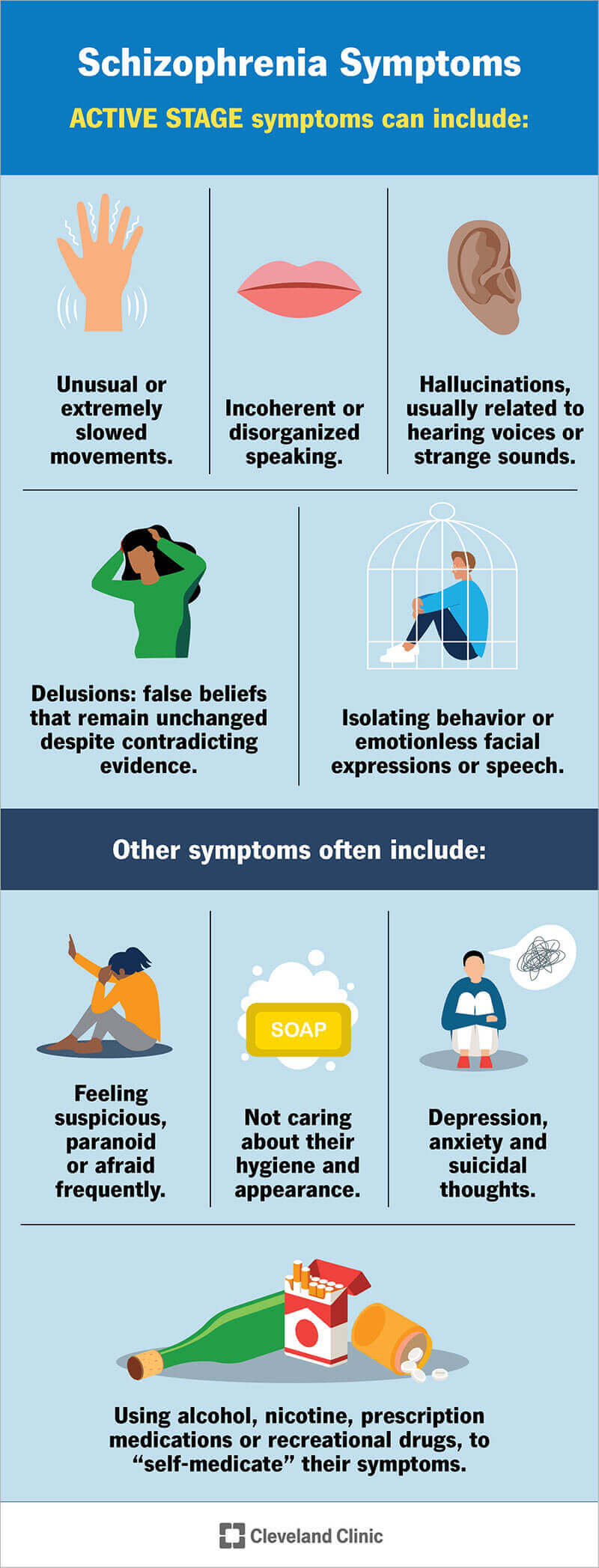
The active stage is when the five main symptoms of schizophrenia are most likely to happen. Those symptoms can include a combination of the following:
- Delusions. These are false beliefs that a person won’t change even when there’s plenty of evidence that those beliefs are wrong. An example of a very severe delusion would be that someone is controlling what you think, say or do.
- Hallucinations. These are things that don’t exist, but you still think you can see, hear, smell, touch or taste them. Hallucinations in schizophrenia (and the related spectrum of conditions) are usually things you can hear, especially hearing voices.
- Disorganized or incoherent speaking. People with schizophrenia often have trouble organizing their thoughts while speaking. They may have trouble staying on topic, or it can be so severe that you can’t understand them because their sentences are jumbled or incoherent.
- Disorganized or unusual movements. This symptom can take various forms, from childish and silly movements to abrupt, upset movements. It can also include catatonic behavior, where a person doesn’t react as expected to the world around them. They might hold a certain pose (even an uncomfortable one), not respond to people speaking to them or might start moving around excessively for no obvious reason.
- Negative symptoms. These refer to decreases in certain behaviors, not symptoms that are bad. Negative symptoms usually involve a decrease in emotion in a person’s facial expressions, how they speak (such as with a flat and emotionless voice), and fewer or no gestures with their hands or other parts of their body. They also involve a lack of motivation, especially when they don't want to socialize or do things they ordinarily enjoy.
Are there other possible symptoms?
People with schizophrenia often experience the following:
- Feeling suspicious, paranoid or afraid frequently.
- Not caring about their hygiene and appearance.
- Depression, anxiety and suicidal thoughts.
- Using alcohol, nicotine, prescription medications or recreational drugs, often to “self-medicate” their symptoms.
Lack of insight
People with schizophrenia commonly show signs of another condition, anosognosia. This condition, often described as “lack of insight,” means a person can’t recognize that they have a medical problem, disorder or illness. Experts estimate that between 50% and 90% of people with schizophrenia have anosognosia. This is one of the reasons that schizophrenia is so difficult to treat.
More than just being in denial of having a problem, this means a person is incapable of recognizing that they have the signs and symptoms of schizophrenia. That often leads them to believe they don’t need medical care and treatment. Anosognosia can also indirectly fuel schizophrenic delusions, making a person believe that someone is trying to poison or harm them, when those people are actually trying to help.
What causes schizophrenia and its spectrum of conditions?
Schizophrenia and the related spectrum of conditions don’t have a single confirmed cause. Several factors and circumstances increase a person’s risk of developing it, but none of them is a guarantee that you’ll eventually have it.
Experts suspect schizophrenia happens for different reasons. The three main reasons include:
- Imbalances in chemical signals your brain uses for cell-to-cell communication.
- Brain development problems before birth.
- Loss of connections between different areas of your brain.
Risk factors
While there aren’t any confirmed causes of schizophrenia, there are several factors and circumstances that researchers have connected to the condition.
- Genetics. People with a family history of schizophrenia — especially a parent or sibling with it — have a much higher risk of developing this condition.
- Environment. Many factors in the world around you can increase your risk of developing schizophrenia. Being born during the winter increases your risk slightly. Certain illnesses that affect your brain, including infections and autoimmune diseases (where your immune system attacks part of your body), can also increase your risk. Extreme stress for long periods can also play a role in developing it.
- Development and birth circumstances. How you developed before you were born plays a role in schizophrenia. The risk of having schizophrenia goes up if your mother had gestational diabetes, preeclampsia, malnutrition or a vitamin D deficiency while she was pregnant with you. The risk also increases if you were underweight at birth or if there were complications during your birth (such as your mother needing to undergo an emergency cesarean section).
- Recreational drug use. Researchers have linked schizophrenia with certain recreational drugs, especially in larger amounts and earlier in life. The connection between heavy marijuana (cannabis) use as a teenager is one of the best-studied of these links. However, there’s disagreement on whether or not marijuana use is a direct cause of schizophrenia or if it’s just a contributing factor.
Is it contagious?
Schizophrenia isn’t contagious, so it can’t spread from person to person.
How is it diagnosed?
Your (or your loved one’s) healthcare provider can diagnose schizophrenia or its related disorders based on a combination of questions they ask, the symptoms you describe or by observing your actions. They’ll also ask questions to rule out causes other than schizophrenia. They then compare what they find to the criteria required for a schizophrenia diagnosis.
According to the DSM-5, a schizophrenia diagnosis requires the following:
- At least two of five main symptoms. Those symptoms, explained above, are delusions, hallucinations, disorganized or incoherent speaking, disorganized or unusual movements and negative symptoms.
- Duration of symptoms and effects. The key symptoms you have must last for at least one month. The condition’s effects (whether or not they meet the full criteria for the symptoms) must also last for at least six months.
- Social or occupational dysfunction. This means the condition disrupts either your ability to work or your relationships (friendly, romantic, professional or otherwise).
What tests will be done to diagnose this condition?
There aren’t any diagnostic tests for schizophrenia-spectrum conditions. But healthcare providers will likely run tests to rule out other conditions before diagnosing schizophrenia. The most likely types of tests include:
- Imaging tests. Healthcare providers will often use computerized tomography (CT), magnetic resonance imaging (MRI) and other imaging tests to rule out problems like stroke, brain injuries, tumors and other changes to your brain structure.
- Blood, urine and cerebrospinal fluid (spinal tap) tests. These tests look for chemical changes in bodily fluids that might explain changes in your behavior. They can rule out heavy metal toxicity or other causes of poisoning, infections and more.
- Brain activity testing. An electroencephalogram (EEG) detects and records the electrical activity in your brain. This test can help rule out conditions like epilepsy.
How is it treated, and is there a cure?
Schizophrenia isn’t curable, but it is often treatable. In a small percentage of cases, people can recover from schizophrenia entirely. However, this isn’t a cure because there isn’t a way of knowing who will have a relapse of this condition and who won’t. Because of that, experts consider those who recover from this condition “in remission.”
Treating schizophrenia usually involves a combination of medication, therapy and self-management techniques. While therapy alone is often effective for treating most mental health conditions, managing schizophrenia usually requires medication. Early diagnosis and treatment are important because they increase the chances of a better outcome.
What medications or treatments are used?
Treating schizophrenia and related conditions typically involves multiple methods. Those methods can happen in combinations or steps.
Medications
There are two main types of medications that treat schizophrenia.
- Typical antipsychotics. Also known as first-generation antipsychotics, these medications block how your brain uses dopamine, a chemical your brain uses for cell-to-cell communication.
- Atypical antipsychotics. These medications, also called second-generation antipsychotics, work differently from first-generation antipsychotics. These block both dopamine and serotonin, two key communication chemicals in your brain. Clozapine is a particularly effective medication that can treat symptoms of schizophrenia when other drugs don’t work. However, it has a rare serious side effect that requires frequent blood monitoring to keep people safe, which is why healthcare providers usually recommend other antipsychotics first.
There are other medications your healthcare provider might also prescribe to treat other symptoms that happen alongside or because of your schizophrenia symptoms. They might also prescribe medications to help reduce side effects of antipsychotic medications such as tremors.
In general, your healthcare provider is the best person to talk to about the medications they might prescribe. They can give you more specific information related to your specific situation, including your life circumstances, medical history and personal preferences.
Psychotherapy
Psychotherapy methods like cognitive behavioral therapy can help people with schizophrenia cope with and manage their condition. Long-term therapy can also help with secondary problems alongside schizophrenia, such as anxiety, depression or substance use issues.
Another key way therapy helps is with treatment adherence. As mentioned above, people with schizophrenia often don’t understand or recognize their symptoms, so they feel like they don’t need treatment. People with schizophrenia who continue therapy are more likely to follow treatment plans and guidance from their healthcare providers.
Other therapy methods that might help include art therapy and drama therapy, which can aid with loss of motivation and a person’s ability to recognize their symptoms. Healthcare providers might also recommend techniques that focus on helping with social skills, setting up self-care routines and more.
Electroconvulsive therapy
In cases where a person’s schizophrenia doesn’t improve after trying certain medications, and the person is at-risk for self-harm or harming others, healthcare providers might recommend adding electroconvulsive therapy (ECT). This treatment can bring rapid improvements when medication alone will take too long to have an effect.
When other treatments don’t work, ECT is often the only one that will, and it can be lifesaving when people are at high risk of suicide. Despite this, ECT use isn’t common because it carries a heavy stigma and because TV, movies and other media are rarely accurate in showing how this treatment happens.
This treatment involves using an electrical current applied to your scalp, stimulating certain parts of your brain. That stimulation causes a brief seizure, which can help improve brain function for people with severe depression, agitation and other problems. People who receive ECT receive anesthesia, so they’re asleep when this procedure happens and it isn’t painful.
What are the possible complications and side effects of schizophrenia treatments?
The possible complications and side effects from treatments for schizophrenia depend greatly on several factors. Those include the treatments you receive, your medical history, the severity of your case and more.
Because the side effects can vary greatly from person to person, your healthcare provider is the best person to tell you about the possible side effects and what you can do about them. They can give you information that best fits your case, offer guidance on what to watch for and tell you how to manage those side effects.
How can I take care of myself or manage my symptoms?
Schizophrenia is a serious mental health condition, and you should never try to self-diagnose or self-treat without first seeing a healthcare provider. (For more information about how to care for yourself after diagnosis, see the Living With section.) It’s also important to get treatment sooner rather than later because early diagnosis and treatment improve the odds of a positive outcome.
How soon after treatment will I feel better?
Your healthcare provider is the best person to tell you how long it will take for medication and therapy to work, as different medications take different amounts of time before their effects are noticeable. They can also tell you about other treatment options that might help if the first attempt isn’t effective.
How can I reduce my risk or prevent this condition?
Because experts still don’t know why schizophrenia happens, it’s impossible to prevent it or reduce your risk of it happening.
What can I expect if I have this condition?
Schizophrenia is a condition where the outlook varies greatly from person to person. People who have schizophrenia tend to struggle with work, relationships and self care. However, with treatment, some are able to work, care for themselves and have fulfilling relationships.
This condition also often affects people in cycles. That means many people with this condition go through periods where the condition flares up and their symptoms get much worse, followed by a period where symptoms improve but they still have some ongoing struggles.
Despite how serious this condition is, treatment does make it possible for people with schizophrenia to live with the condition and minimize how it affects their lives.
How long does schizophrenia last?
Schizophrenia is a lifelong condition. While some people will recover from this condition after having only one or two episodes, schizophrenia symptoms can return unpredictably. People with a history of schizophrenia are “in remission” as long as symptoms don’t return.
What’s the outlook for this condition?
Schizophrenia itself isn’t a deadly condition. However, its effects on a person can lead to dangerous or harmful behaviors, to both themselves and the people around them.
About one-third of people with schizophrenia will have symptoms that worsen over time. That can happen because their symptoms won’t respond to treatment, or that person won’t follow treatment plans closely enough to manage their condition. About 10% of people with schizophrenia die by suicide.
People with schizophrenia also have an increased risk of chronic health problems, especially heart disease. They often also struggle with problems that happen because of long-term substance use disorders. Many can’t care for themselves because of issues with employment or relationships, too, and many end up homeless.
Approximately another one-third of people with schizophrenia will respond to treatment overall. However, they’ll still have periods where symptoms return and worsen. They might also have lingering problems, such as trouble focusing or thinking, because of earlier episodes of this condition. However, they’ll live normal — or mostly normal — lives overall.
Of the remaining one-third of people with this condition, about 10% will go into remission and won’t have major symptoms from this condition for the rest of their lives. Another 20% or so will have an overall positive outcome, meaning they respond to treatment, their symptoms are manageable and they'll live their life without major impact from the condition.
How do I take care of myself?
People with schizophrenia should do the following to help care for themselves and manage their condition:
- Take medications as prescribed. One of the most critical things a person with schizophrenia can do to help themselves is to take their medications. If you have schizophrenia, you should not stop your medication without talking to your healthcare provider. Sudden stopping of medication often speeds up the return of psychosis symptoms. Side effects are common with antipsychotics. However, there are many antipsychotic medications, so it’s often possible to work with your healthcare provider to find one that both works well for you and has minimal or no side effects.
- See your healthcare provider as recommended. Your healthcare provider will set up a schedule for you to see them. These visits are especially important to help with managing your condition.
- Don’t ignore or avoid symptoms. Schizophrenia is more likely to respond and have a good outcome with early diagnosis and treatment.
- Avoid alcohol and recreational drug use. Alcohol and drug use can make schizophrenia symptoms worse and can lead to other issues. This includes using prescription medications in a way other than prescribed.
- Consider seeking support. Organizations such as the National Alliance on Mental Illness can offer resources and information that can help.
When should I see my healthcare provider?
You should see your healthcare provider as recommended. You should also see them if you notice a change in your symptoms, such as symptoms getting worse even if you’re taking your medication. You can also see them if side effects of your medication are causing disruptions in your life. Your healthcare provider can sometimes recommend alternative medications or treatments that might better treat your condition without causing those same effects.
When should I go to ER?
You should go to the ER or call 911 (or your local emergency services number) if you have thoughts about harming yourself, including thoughts of suicide, or about harming others. If you have thoughts like this, you can call any of the following:
- Suicide and Crisis Lifeline (United States). To call this line, dial 988.
- Local crisis lines. Mental health organizations and centers in your area may offer resources and help through crisis lines.
- 911 (or your local emergency services number): You should call 911 (or the local emergency services number) if you feel like you’re in immediate danger of harming yourself. Operators and dispatchers for 911 lines can often help people in immediate danger because of a severe mental crisis and send first responders to assist.
What can I do if a loved one shows signs of schizophrenia or a similar condition?
Because people with schizophrenia often can’t recognize their symptoms or condition, they often don’t believe they need medical care or treatment. That can be frustrating or frightening for both the person with the symptoms and those who care about them.
If you notice a loved one showing signs of schizophrenia or a related condition, you can try helping them by doing the following:
- Ask how you can help. People with schizophrenia may talk about their symptoms without realizing that these indicate a mental health condition. Listening and offering your help keeps a line of communication open and helps them feel connected to others.
- Encourage them to see someone who can help. Treatment for schizophrenia, especially medication, can improve a person’s symptoms and help them recognize what’s real and what isn’t. Often, that can help them understand that they need medical care.
- Don’t judge or argue. People with schizophrenia have trouble recognizing what’s real and what isn’t. They may hear or see things that feel as real to them as what you see and hear around you. Avoid judging them or arguing with them about what’s real and what isn’t, even if you have evidence. People experiencing hallucinations or delusions usually don’t respond to evidence because they can’t tell what’s real and what isn’t.
- Stay calm. Becoming angry or frustrated can make it harder to reach out to a person with schizophrenia. If they’re agitated or angry, don’t raise your voice, and try to make the area around you as calm and quiet as possible. You should also make sure they don’t feel trapped or otherwise threatened.
- Get help in emergencies. People with schizophrenia are much more likely to die by suicide. If they talk about thoughts of harming themselves or others, or if they show severe paranoia, agitation or act abusively or violently, you should call your local emergency services immediately.
A note from Cleveland Clinic
Schizophrenia can be a frightening condition for the people who have it and their loved ones. Despite stereotypes, this isn’t a condition where any thought of recovery or living a happy, fulfilling life is impossible. If you think you have symptoms of schizophrenia, it’s important to talk to a healthcare provider as soon as you can. Their job is to help you, and healthcare providers — especially those who specialize in mental health conditions like schizophrenia — have the training to help you not feel judged, ashamed or embarrassed. If you notice a loved one struggling with symptoms of psychosis or schizophrenia, encourage them gently and supportively to get care. Early diagnosis and treatment can make a big difference in helping people recover and manage this condition.