

What is carcinoid syndrome?
Carcinoid syndrome, once called carcinoid tumors, is a set of symptoms that might be signs you have neuroendocrine tumors. Neuroendocrine tumors (NETs) are tumors that start in specialized cells in your neuroendocrine system. These neuroendocrine cells are scattered throughout your body, making and releasing hormones. Hormones are chemicals that coordinate different body functions, let your body know what to do and when to do it.
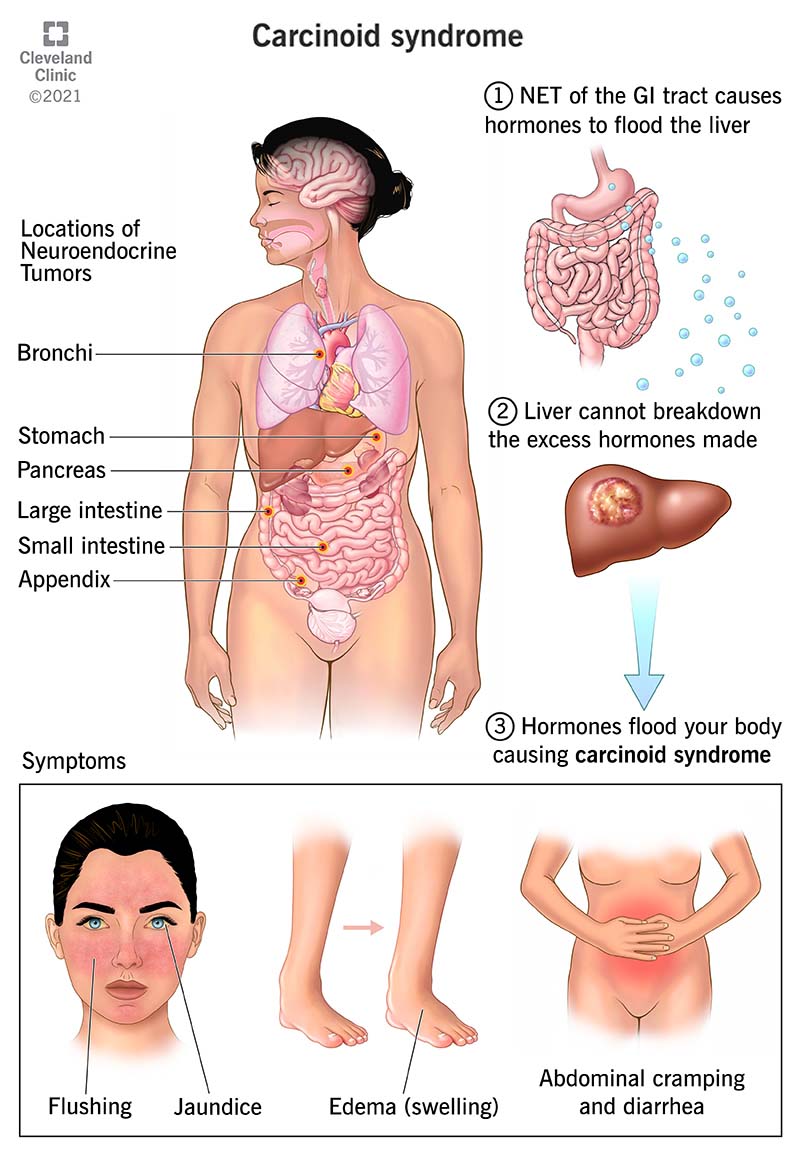
NETs happen when your neuroendocrine cells begin to rapidly divide and multiply. Carcinoid syndrome happens when NETs in your gastrointestinal tract (NETs of GI) flood your system with the hormone serotonin and other substances.
Who is affected by carcinoid syndrome?
Carcinoid syndrome can affect people who have neuroendocrine tumors in their digestive systems or lungs. Like neuroendocrine tumors, carcinoid syndrome is a rare condition. Each year, 10 in 1 million people in the U.S. develop the syndrome.
What causes carcinoid syndrome?
Carcinoid syndrome happens when your gastrointestinal (GI) tract produces and sends too many hormones to your liver. Normally, your liver manages the flow, even when an NET boosts hormone production. But when your GI tract produces too many hormones or if you have an NET in your liver that keeps it from processing and removing the hormones, your hormones can flood your system, triggering carcinoid syndrome.
When there’s too large of an amount of hormone produced, or if neuroendocrine tumors in your liver prevent it from being able to process and remove the hormones produced, they can flood your system, triggering carcinoid syndrome.
What are carcinoid syndrome symptoms?
Uncomfortable flushing of your head and neck and watery diarrhea are the most common and earliest symptoms of carcinoid syndrome. Unfortunately, many carcinoid syndrome symptoms resemble other illnesses’ symptoms. Carcinoid syndrome has been misdiagnosed as menopause, Crohn’s disease and irritable bowel syndrome (IBS). Talk to your healthcare provider if you’ve had the following symptoms:
- Abdominal cramping and explosive, frequent diarrhea.
- Fatty poops that smell bad.
- Edema or swelling of your feet and legs. This can be a symptom of heart failure.
- Wheezing and shortness of breath.
- Some people might lose interest in sex or have erectile dysfunction.
- Jaundice, which is when your skin and whites of your eyes turn yellow.
- Dizziness or feeling faint. This can be a sign of low blood pressure.
- Feeling like your heart is racing.
How is carcinoid syndrome diagnosed?
Carcinoid syndrome can be difficult to diagnose because so many of its symptoms are similar to other illnesses. Healthcare providers might diagnose carcinoid syndrome by first ruling out other causes for flushing, wheezing and diarrhea, which are the three most significant carcinoid syndrome symptoms.
What tests are used to diagnose carcinoid syndrome?
Healthcare providers use blood and urine tests, followed by imaging tests. The blood and urine tests identify biomarkers such as the presence or absence of certain substances and hormones. The imaging tests will confirm that a neuroendocrine tumor is responsible for your carcinoid syndrome.
Those tests may include:
- Urine test. This test checks on certain hormone levels.
- Physical exam and medical history. Many carcinoid syndrome symptoms are similar to other less serious illnesses. Your healthcare provider will ask questions about specific symptoms, how long you’ve had the symptoms and if your symptoms are getting worse.
- Blood tests. These tests check on the amounts of substances that your organs and tissues release into your blood. Substance levels that spike or fall might be signs of disease.
- Neuroendocrine positron emission tomography (PET) scan. This test tracks neuroendocrine tumors with a dye called Gallium 68 dotatate.
- Computed tomography (CT) scan. CT scans use X-rays and a computer to produce 3-D images of organs and bones.
- Ultrasound. Ultrasounds use sound waves to develop images of organs and bones.
- Magnetic resonance imaging (MRI).
- Endoscopy. This test uses a long thin tube with a camera and a light that’s inserted into your body.
How is carcinoid syndrome treated?
Carcinoid syndrome is a sign you might have neuroendocrine tumors. Treating the tumors also treats your carcinoid syndrome. Those treatments include:
- Surgery. Surgery to remove or reduce the size of your neuroendocrine tumors.
- Somatostatin analogs. Somatostatin analogs are a type of treatment that may stop your body from making too many hormones. This may slow down the growth of the tumor when cancer cells spread to other parts of your body.
- Targeted therapy. Targeted therapy is a type of treatment that uses drugs that target certain genes or proteins to kill cancer cells.
- Chemotherapy. This treatment uses drugs that destroy cancer cells.
How can I prevent carcinoid syndrome?
While you can’t prevent carcinoid syndrome, you can take steps to prevent a serious form of carcinoid syndrome called carcinoid crisis.
What is carcinoid crisis?
Carcinoid crisis is an extremely rare but life-threatening condition that can happen if your carcinoid syndrome goes undiagnosed or untreated. This often occurs during surgeries or procedures or in trauma situations like an injury from a car accident. Long-term carcinoid syndrome can cause the following:
- Congestive heart failure. Carcinoid syndrome can damage your heart valves, causing heart failure.
- Severe diarrhea that might cause electrolyte imbalance.
- Heart palpitations.
- Severe stomach pain.
- Blood pressure changes.
- Acute flushing of your face and neck.
How can I prevent carcinoid crisis?
You can prevent carcinoid crisis by monitoring symptoms such as flushing, wheezing and diarrhea. If these symptoms last for several days, contact your healthcare provider. Your symptoms might not be related to NETs or carcinoid syndrome, but it’s always a good idea to check. Here are some other suggestions:
- Surgery can trigger a carcinoid crisis. If you know you have NET or carcinoid syndrome, consider carrying a card that lists your medical condition in case you need emergency medical care.
- If you’re planning on surgery, be sure your healthcare providers know you have NET or carcinoid syndrome. They may provide somatostatin analogs before, during and after your surgery so you don’t have a carcinoid crisis.
What’s the prognosis for carcinoid syndrome?
If you’ve been diagnosed with carcinoid syndrome, you might also have a neuroendocrine tumor, or NET. These are rare tumors that can be treated with surgery, targeted therapies and chemotherapy. While an NET is a serious illness, more than 77% of people who have neuroendocrine tumors are alive five years after treatment.
How do I take care of myself?
If you have carcinoid syndrome, you probably also have a neuroendocrine tumor. If you have carcinoid syndrome symptoms, tell your healthcare provider. They’ll be able to assess your situation and recommend tests to determine if you have an NET.
The three main carcinoid syndrome symptoms are flushing, wheezing and diarrhea. Here are some suggestions for managing those symptoms:
- Flushing. Flushing is your nervous system’s reaction to physical or emotional stress. You can ease flushing by taking deep breaths, cooling your face and chest with a damp cloth or getting some fresh air. Avoiding alcohol can reduce flushing.
- Wheezing. Try drinking herbal tea and using a vaporizer to help your breathing. If you smoke, try to stop. Smoking irritates your airways.
- Diarrhea. If diarrhea is an issue, talk to your healthcare provider about ways to reduce its frequency and severity. They may recommend medication to ease your diarrhea.
When should I see my healthcare provider?
You should see your healthcare provider if your carcinoid syndrome symptoms get worse. If you’re being treated for a neuroendocrine tumor, contact your healthcare provider if you notice changes in your body that resemble your NET symptoms. These changes might be unrelated to your NET diagnosis, and the best way to be sure of that is to talk to your healthcare provider. You should also contact your healthcare provider if your symptoms or treatment side effects worsen.
When should I go to the emergency room?
Carcinoid syndrome symptoms get worse over time if untreated and can become a life-threatening condition called carcinoid crisis. Go to the emergency room if:
- You’re having heart palpitations or chest pain.
- You have severe diarrhea that’s lasted several days.
- You have severe stomach pain.
- You feel faint.
- You have acute flushing of your face, neck and chest.
What questions should I ask my healthcare provider?
Carcinoid syndrome might be a sign you have a neuroendocrine tumor. While you’ll have questions about carcinoid syndrome, you’ll probably have more questions about NETs. Some questions you might want to ask your healthcare provider include:
- If I have carcinoid syndrome, how do I find out if I have a neuroendocrine tumor?
- If I have a tumor, where’s it located in my body?
- What’s the treatment for my tumor?
- What are the treatment side effects?
- Can you cure the neuroendocrine tumor that caused my carcinoid syndrome?
- Can carcinoid syndrome come back after you treat my neuroendocrine tumor?
A note from Cleveland Clinic
A carcinoid syndrome diagnosis is your body's signal that you might have a rare cancer called neuroendocrine tumor, or NET. NETs can be treated. Learning you have carcinoid syndrome is your first step toward finding out if you have cancer — and if you do, how that cancer can be treated. If you’ve been diagnosed with carcinoid syndrome, ask your healthcare provider about next steps to confirm potential NETs.