

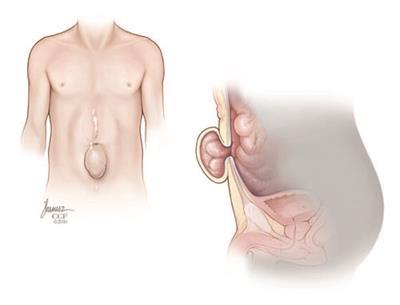
What is a ventral hernia?
A hernia occurs when there is a hole in the muscles of the abdominal wall, allowing a loop of intestine or abdominal tissue to push through the muscle layer. A ventral hernia is a hernia that occurs at any location along the midline (vertical center) of the abdomen wall. There are three types of ventral hernia:
- Epigastric (stomach area) hernia: Occurs anywhere from just below the breastbone to the navel (belly button). This type of hernia is seen in both men and women.
- Umbilical (belly button) hernia: Occurs in the area of the belly button.
- Incisional hernia. Develops at the site of a previous surgery. Up to one-third of patients who have had an abdominal surgery will develop an incisional hernia at the site of their scar. This type of hernia can occur anytime from months to years after an abdominal surgery.
What are the causes and risk factors for developing a ventral hernia?
There are many causes including:
- Weakness at the incision site of a previous abdominal surgery (which could result from an infection at the surgery site or failed surgical repair/mesh placement).
- Weakness in an area of the abdominal wall that was present at birth.
- Weakness in the abdominal wall caused by conditions that put strain on the wall. These include:
- Being overweight
- Frequent coughing episodes
- Severe vomiting
- Pregnancy
- History of lifting or pushing heavy objects
- Straining while having a bowel movement/urinating
- Injuries to the bowel area
- Lung diseases (chronic obstructive pulmonary disease and emphysema; struggling to breathe puts strain on the abdominal wall)
- Prostatism (enlargement of the prostate gland, which causes straining while urinating in older men)
- Older age (general loss of elasticity to abdominal wall)
What are the signs and symptoms of a ventral hernia?
Some patients don’t feel any discomfort in the early stages of ventral hernia formation. Often, the first sign is a visible bulge under the skin in the abdomen or an area that is tender to the touch. The bulge may flatten when lying down or pushing against it.
A ventral hernia causes an increasing level of pain when a person:
- Lifts heavy objects.
- Strains to have a bowel movement/urinate.
- Sits or stands for long periods of time.
Severe abdominal pain can occur if part of the intestine bulges through the abdominal wall and becomes trapped in the opening. If this happens, the trapped portion of the intestine becomes strangled, loses its blood supply and starts to die. This is a medical emergency that requires immediate care.
How is a ventral hernia diagnosed?
Your doctor will review your medical and surgical history. He or she will also perform a physical exam of the abdominal area where a ventral hernia may have occurred. Your doctor may then order imaging tests of the abdomen to look for signs of a ventral hernia. These tests may include an ultrasound, computed tomography (CT) scan or a magnetic resonance imaging (MRI) study.
How is a ventral hernia repaired?
Ventral hernias do not go away or get better on their own and require surgery to repair. In fact, without treatment, ventral hernias can get larger and worsen with time. Untreated hernias can become difficult to repair and can lead to serious complications, such as strangulation of a portion of the intestine.
The goal of ventral hernia surgery is to repair the hole/defect in the abdominal wall so that the intestine and other abdominal tissue cannot bulge through the wall again. The surgery often restores the tone and shape of the abdominal wall by repairing the hole and bringing the muscles back to their normal position.
There are three main types of hernia repair surgeries: open, laparoscopic and robotic:
- Open hernia repair: An open incision is made in the abdomen where the hernia has occurred, and the intestine or abdominal tissue is pushed back into place. A mesh material is placed to reinforce this repair and reduce hernia recurrences. The skin is usually closed with dissolvable stitches and glue.
- Laparoscopic surgery: Several small incisions are made away from where the hernia has occurred. A laparoscope (a thin lighted tube with a camera on the tip) is inserted through one of the openings to help guide the surgery. A surgical mesh material may be inserted to strengthen the weakened area in the abdominal wall. Advantages of this approach compared with open hernia repair include a lower risk of infection, because smaller-sized incisions are used.
- Robotic hernia repair: Like laparoscopic surgery, robotic surgery uses a laparoscope, and is performed in the same manner (small incisions, a tiny camera). Robotic surgery differs from laparoscopic surgery in that the surgeon is seated at a console in the operating room, and handles the surgical instruments from the console. While robotic surgery can be used for some smaller hernias, or weak areas, it can now also be used to reconstruct the abdominal wall. Other benefits of robotic hernia surgery are that the patient has tiny scars rather than one large incision scar, and there may be less pain after this surgery compared to open surgery.
Your surgeon will consider several factors to help determine the best surgical hernia repair method for you, including:
- Your age
- Existing health problems and medical history
- The size of the hernia
- The size and contour of the abdominal wall
- Amount of skin that can be used for the repair, and
- Presence of infection.
Importantly, your hernia repair is tailored to your specific situation based on the goals of the procedure and expected outcomes.
Where can I learn more about open ventral hernia repair?
You can learn more about the open ventral hernia repair from this surgery guide.