

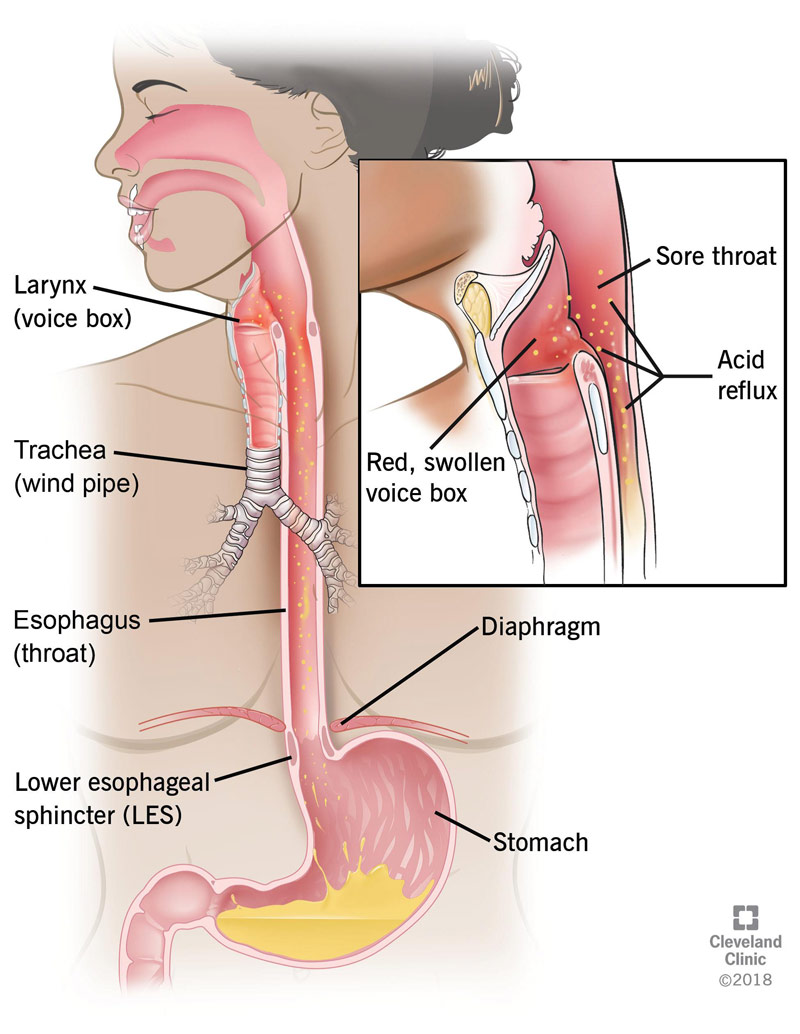
What is laryngopharyngeal reflux?
Laryngopharyngeal reflux (LPR) is a condition in which acid that is made in the stomach travels up the esophagus (swallowing tube) and gets to the throat.
Who gets laryngopharyngeal reflux?
Anyone can get LPR, but it occurs more often as people age. People who are more likely to have LPR include those who:
- Have certain dietary habits.
- Consistently wear tight or binding clothing.
- Are overweight.
- Are overstressed.
What causes laryngopharyngeal reflux?
LPR is caused by stomach acid that bubbles up into the throat. When you swallow, food passes down your throat and through your esophagus to your stomach. A muscle called the lower esophageal sphincter controls the opening between the esophagus and the stomach. The muscle remains tightly closed except when you swallow food.
When this muscle fails to close, the acid-containing contents of the stomach can travel back up into the esophagus. This backward movement is called reflux.
What are the symptoms of laryngopharyngeal reflux?
The symptoms of LPR are felt in the throat and include the following:
- Sore throat
- Mild hoarseness
- Sensation of a lump in the throat
- The need to clear the throat
- The sensation of mucus sticking in the throat, and/or post-nasal drip
- Chronic (long-term) cough
- Difficulty swallowing
- Red, swollen, or irritated larynx (voice box).
How is laryngopharyngeal reflux diagnosed?
LPR is usually diagnosed based on the patient’s symptoms of irritation or swelling in the throat and the back of the voice box. In many cases, no testing is needed to make the diagnosis.
If testing is needed, three commonly used tests are: a swallowing study; a direct look at the stomach and esophagus through an endoscope, and; an esophageal pH test:
- In a swallowing study, the patient swallows a special liquid called barium, which coats the esophagus, stomach and intestine so they are outlined on an X-ray. This allows the doctor to see the movement of food as it passes from the mouth to the esophagus.
- The doctor can also view the inside of the stomach and esophagus with an endoscope, a long thin tube with a camera on the end that the doctor passes through the mouth, down the esophagus and into the stomach.
- The esophageal pH test measures and records the pH (level of acid) in the esophagus. A thin, small tube with a device on the tip that senses acid is gently passed through the nose, down the esophagus, and positioned about 2 inches above the lower esophageal sphincter. The tube is fastened to the side of the face with tape. The end of the tube that comes out of the nose is attached to a portable recorder that is worn on the belt or over the shoulder. The recorder has several buttons on it that the patient presses to mark certain events.
How is laryngopharyngeal reflux treated?
Most cases of LPR do not need medical care and can be managed with lifestyle changes, including the following:
- Follow a bland diet (low acid levels, low in fat, not spicy).
- Eat frequent, small meals.
- Lose weight.
- Avoid the use of alcohol, tobacco and caffeine.
- Do not eat food less than 2 hours before bedtime.
- Raise the head of your bed before sleeping. Place a strong, solid object (like a board) under the top portion of the mattress. This will help prop up your head and the upper portion of your body, which will help keep stomach acid from backing up into your throat.
- Avoid clearing your throat.
- Take over-the-counter medications, including antacids, such as Tums®, Maalox®, or Mylanta; stomach acid reducers, such as ranitidine (Tagamet® or Zantac®); or proton pump inhibitors, such as omeprazole (Prilosec®), pantoprazole (Protonix®), and esomeprazole (Nexium®). Be sure to take all medications as directed.
In very severe cases of LPR, surgery may be recommended as treatment.
What can happen if laryngopharyngeal reflux is not treated?
If it is not treated, LPR can lead to:
- Sore throat
- Chronic cough
- Swelling of the vocal folds
- Ulcers (open sores) on the vocal folds
- Formation of granulomas (masses) in the throat
- Worsening of asthma, emphysema, and bronchitis
Untreated LPR also may play a role in the development of cancer of the voice box.
Can laryngopharyngeal reflux be prevented?
To decrease your chance of having LPR, avoid the following:
- Acidic, spicy and fatty foods
- Alcohol
- Tobacco
- Beverages that contain caffeine (tea, coffee, soda, etc.)
- Chocolate
- Mint or mint-flavored foods
Other things you can do to help prevent LPR:
- Do not wear tight or binding clothing.
- Avoid becoming overly stressed. Learn ways to help manage or reduce stress levels.
- Be sure to maintain a healthy weight.
- Avoid eating less than 2 hours before bedtime.
What is the prognosis (outlook) for patients who have laryngopharyngeal reflux?
The prognosis for patients who have LPR is good because most of the causes can be controlled with a healthy lifestyle. Ask your doctor for other suggestions and tips on treating and preventing LPR.