

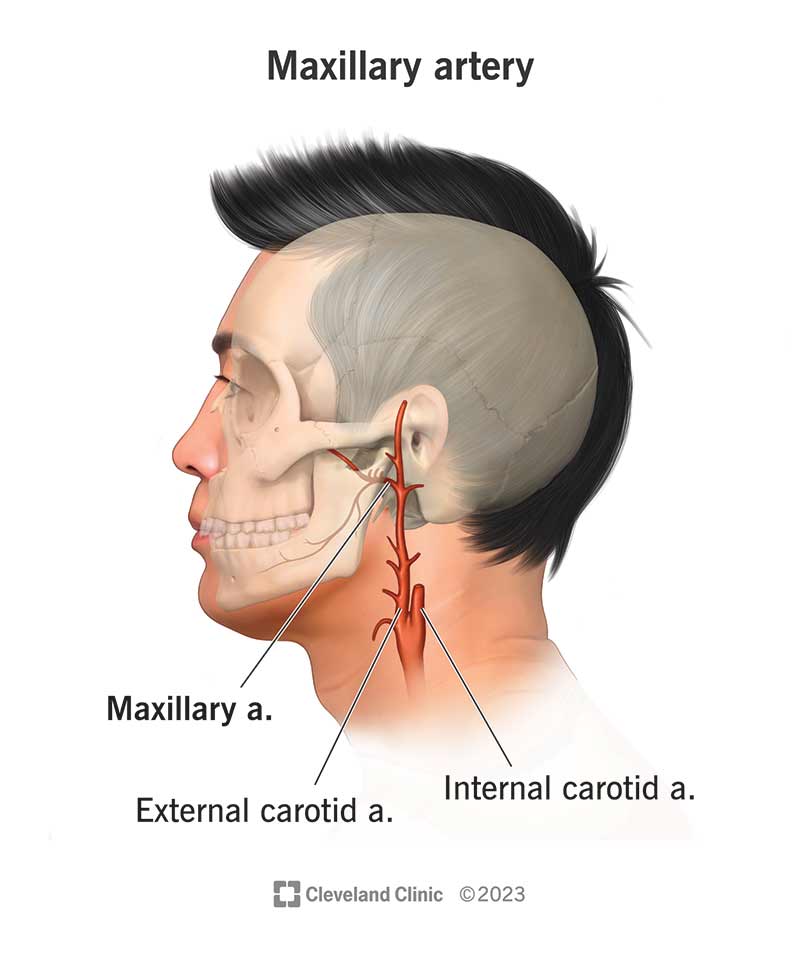
What is the maxillary artery?
The maxillary artery, which some people call the internal maxillary artery, is deep inside each side of your face. Many branches of your maxillary artery run up, down and across your face.
What is the function of the maxillary artery?
The function of the maxillary artery is to supply blood to certain parts of your face. Like all arteries, maxillary arteries bring oxygen and nutrients to your tissues and cells so they can do their jobs.
But healthcare providers also use your maxillary artery to solve certain medical problems, like:
- Using it when they need a bypass route (alternate blood supply) during operations for brain aneurysms or tumors at the base of your skull.
- Using it when doing an endovascular (within a blood vessel) procedure.
- Blocking or closing off the maxillary artery if it’s feeding nosebleeds, tumors or noncancerous growths.
What does the maxillary artery supply?
The maxillary artery supplies blood to parts of your face, like your:
Where is the maxillary artery located?
The maxillary artery branches off from the external carotid artery, which runs up and down your neck. If you think of your carotid artery as going north, your maxillary artery would branch off to the east (or west on the other side of your head) and then the north. It starts in your parotid gland, which is in front of your ear.
Variations in maxillary artery anatomy
Your maxillary artery may run closer to, or farther from, the middle of the muscle in front of your ear. In some people, this may differ from one side of the face to the other. Also, some branches of the maxillary artery may branch off together instead of separately.
In some cases, an artery that usually branches off from a maxillary artery doesn’t — it comes from the external carotid artery instead.
What are the three parts of the maxillary artery?
The three parts of the maxillary artery are the:
- Mandibular section (jawbone, lip and chin area, middle ear).
- Pterygoid section (muscles you use when chewing).
- Pterygopalatine section (roof of your mouth, jaw, teeth, lips, eyelids, inner ears).
What are the maxillary artery branches?
The branches of the maxillary artery are the:
In the mandibular sectionIn the pterygoid sectionIn the pterygopalatine section
· Deep auricular artery.
· Anterior tympanic artery.
· Middle meningeal artery.
· Accessory meningeal artery.
· Inferior alveolar artery.
· Tympanic artery.
· Deep temporal arteries (anterior, middle and posterior).
· Buccal artery.
· Masseteric artery.
· Pterygoid artery.
· Pharyngeal artery.
· Greater palatine artery.
· Artery of the pterygoid canal.
· Sphenopalatine artery.
· Posterior superior alveolar artery.
· Infraorbital artery.
· Vidian artery.
How big is the maxillary artery?
The estimated size of the maxillary artery varies by section.
Mandibular sectionPterygoid sectionPterygopalatine section14 to 16 millimeters (.55 to .62 inches) long.15 to 20 millimeters (.59 to .78 inches) long.11 millimeters (.43 inches) long.Nearly 4 millimeters (.15 inches) in diameter.About 3 millimeters (.12 inches) in diameter.Nearly 3 millimeters (.12 inches) in diameter.
What are the common conditions and disorders that affect the maxillary artery?
Conditions that may affect your maxillary artery include:
- Temporal arteritis (giant cell arteritis), inflammation of your arteries.
- Aneurysm (rare), a stretched-out artery wall.
- Pseudoaneurysm (rare), an injured artery wall.
What are common signs or symptoms of maxillary artery conditions?
Signs or symptoms of conditions that affect your maxillary artery include:
- A swollen area in front of your ear.
- A pulsing lump in front of your ear.
- Fever.
- Headaches.
- Double vision.
- Pain in your temples or jaw.
- Pain while chewing.
What are common tests to check the health of the maxillary artery?
A provider can see the maxillary artery with imaging tests, like:
- Ultrasound (using sound waves).
- Computed tomography (CT) scan (using X-rays and a computer).
- Magnetic resonance angiogram (MRA) scan (using an MRI).
- Angiogram (using X-rays and contrast dye).
Your provider may also perform a physical examination to assess for signs and symptoms of maxillary artery dysfunction.
What are common treatments for the maxillary artery?
Treatments for your maxillary artery may include:
- A minimally invasive operation for an aneurysm or pseudoaneurysm.
- Corticosteroid medicine for temporal arteritis.
How do you keep your maxillary artery healthy?
You can keep your maxillary artery healthy by following these tips:
- Exercise regularly.
- Avoid tobacco products.
- Eat nutritious foods like fruits, vegetables and whole grains.
- Limit the amount of alcohol you drink.
- Limit how much salt you eat.
- Visit your healthcare providers and tell them if you’re having symptoms of maxillary artery dysfunction or disease.
A note from Cleveland Clinic
Well below your skin, your maxillary artery is sending blood to the muscles and tissues in your face. A healthy lifestyle helps you care for all of your blood vessels. Regular checkups with a healthcare provider can help ensure that all is well with your cardiovascular (heart and blood vessel) system. A provider can catch issues early before they become harder to treat.