

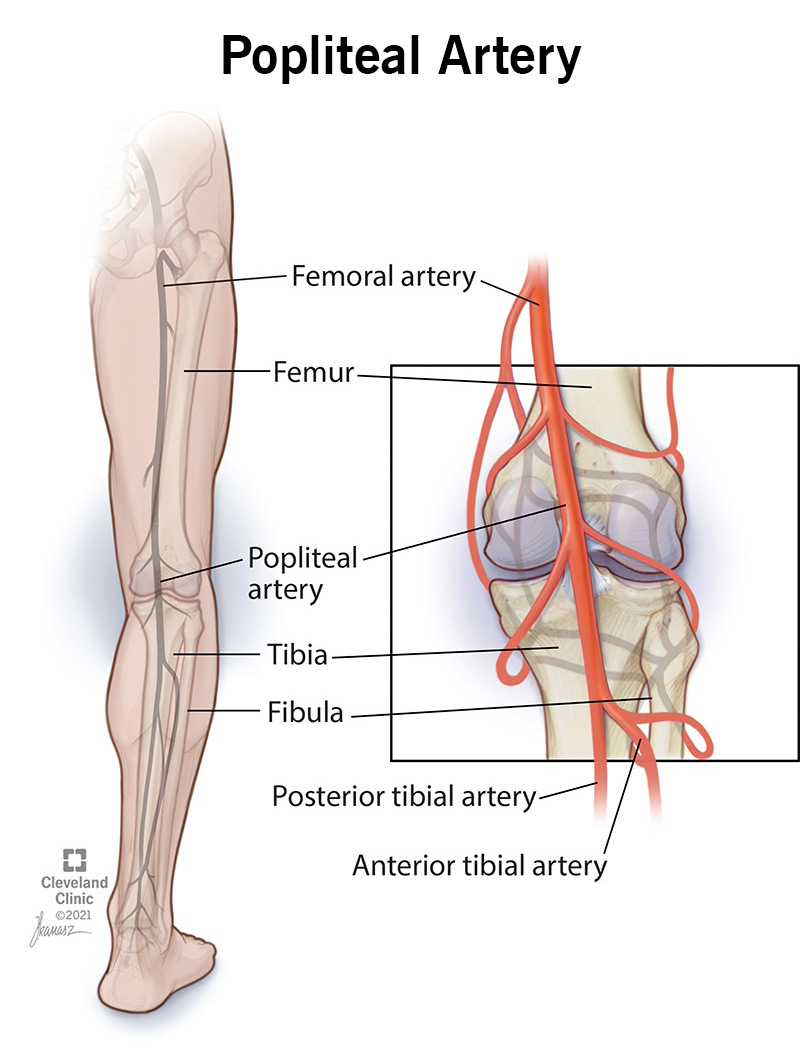
What are the popliteal arteries?
The popliteal arteries are an extension of the femoral arteries in your legs. They start in the middle of your thighs and run behind your knees to bring blood to the lower parts of your leg. You or a healthcare provider can feel your popliteal pulse by placing your fingers on the back of your knee over the popliteal artery.
What is the purpose of the popliteal arteries?
Popliteal arteries are part of your body’s circulatory system. They are peripheral arteries. Peripheral arteries circulate blood to body areas farther from your heart.
The popliteal arteries supply blood to the:
- Fibulas (smaller bones on the outside of the lower legs).
- Knee joints and knee pits (popliteal fossa).
- Lower leg muscles and nerves.
- Tibias (larger bones on the inside of the lower legs).
- Feet and ankles.
Where are the popliteal arteries?
You have two popliteal arteries: one in your right leg and one in your left leg. These arteries are a continuation of the femoral arteries, the large blood vessels that bring blood to your legs.
What are the popliteal artery branches?
Each popliteal artery is located behind your knee and runs behind your knee pit.
Below your knee joint, the arteries divide into the anterior tibial artery and the tibioperoneal (or tibiofibular) trunk. This trunk divides into smaller branches that carry blood to your fibula and to the back of your calf.
After passing through your lower leg/calf, all of these branches from the popliteal artery eventually supply all the blood to your foot.
What conditions and disorders affect the popliteal arteries?
Conditions that affect the popliteal arteries include:
- Cystic adventitial disease: This condition occurs when a cyst forms inside a popliteal artery wall, reducing blood flow. Over time, people can develop narrowed arteries or popliteal artery stenosis. It mostly affects people designated male at birth. Symptoms include lower leg cramping pain with walking or exercise that gradually progresses (these symptoms are called intermittent claudication).
- Popliteal artery aneurysm: An aneurysm is a bulge in an artery wall that weakens it, making it prone to rupture. An aneurysm in a popliteal artery may lead to a blood clot. Severe blockages can result in the need for lower leg amputation if they aren’t identified and treated in time. Popliteal aneurysms are the second most common aneurysm type after abdominal aortic aneurysms. Almost all popliteal aneurysms occur in people designated male at birth.
- Popliteal artery entrapment syndrome (PAES): PAES occurs when muscles and tendons in the knee area put pressure on the popliteal arteries. It causes muscle cramps and muscle pain in your calves during physical activity like walking. This is called intermittent claudication. PAES most often affects athletes, especially men under age 30.
- Popliteal artery atherosclerotic disease: Narrowed arteries due to plaque and blood clots can lead to partial or complete blockages (occlusions). There’s an increased risk of gangrene and limb loss. Like other types of occlusive peripheral arterial disease, it most often affects people who smoke or use tobacco products, those with diabetes, people over age 65 and those with high cholesterol.
- Popliteal artery hemorrhage: Trauma to your knee can cause a knee dislocation and rupture the popliteal artery.
- Popliteal cyst: These are very common and are visible on ultrasound. Also called a Baker’s cyst, this fluid-filled lump forms on the back of your knee. It can cause pain and swelling. The cyst can affect your ability to bend and move your knee. Damage to your knee joint from arthritis or a torn meniscus causes Baker’s cysts. Although they’re both behind your knee, a popliteal cyst generally doesn’t affect the function of the popliteal artery.
What causes popliteal artery conditions?
Risk factors for popliteal artery conditions include:
- Coronary artery disease.
- Diabetes.
- High blood pressure.
- High cholesterol.
- Male sex.
- Having obesity.
- Smoking or using tobacco products.
What are the signs of popliteal artery diseases?
Most popliteal artery diseases cause leg pain or heaviness when you’re walking or physically active. The pain, cramps and heaviness go away when you rest. Healthcare providers call this condition intermittent claudication.
You may also experience:
- Edema (swelling) in the lower leg.
- Nonhealing foot ulcers (sores).
- Pain in your calf, knee pit or foot.
How are popliteal artery diseases diagnosed?
Your healthcare provider may perform these tests to diagnose popliteal artery conditions:
- Pulse volume recordings (PVR) use blood pressure and Doppler to calculate an ankle-brachial index (ABI) for an assessment of arterial blood flow down your legs.
- Vascular ultrasound assesses blood flow in your legs.
- Angiogram, such as a magnetic resonance angiogram (MRA) or CT angiogram (CTA), checks for poor blood circulation in your legs. Catheter angiography can be performed to evaluate the popliteal artery. This test is invasive and generally reserved for special cases after other imaging has been obtained.
What are common treatments for popliteal artery diseases?
Treatments for popliteal artery diseases vary depending on the condition. They include:
- Medications to lower blood pressure and cholesterol and prevent blood clots.
- Catheter angioplasty and stenting to open a narrowed artery with a balloon device and place a stent (mesh device) inside the artery to keep it open.
- Bypass grafting goes around a blocked artery and sends blood through a newly connected blood vessel (graft).
- Surgery to remove cysts or release muscles and tendons to release pressure on the popliteal artery.
How can I protect my popliteal arteries?
These lifestyle changes can keep your arteries and circulatory system healthy:
- Quit smoking or using tobacco products.
- Exercise most days of the week.
- Follow a heart-healthy diet that’s low in cholesterol, fat and salt.
- Maintain a healthy weight.
- Manage conditions like diabetes, high cholesterol and high blood pressure.
When should I talk to a doctor?
You should call your healthcare provider if you experience:
- Nonhealing leg or foot wounds.
- Pain when walking or movement problems.
- Unexplained leg swelling.
- Change in leg temperature or color.
- Leg pain at rest.
A note from Cleveland Clinic
The popliteal arteries play key roles in bringing blood from the femoral arteries to the lower legs. Popliteal artery diseases can restrict this blood flow, leading to problems like intermittent claudication. You may have leg pain when you walk or move, but not when you rest. Some popliteal artery diseases can lead to limb loss. Your healthcare provider can recommend dietary and lifestyle changes to maintain healthy blood flow throughout the body and can suggest testing or procedures when needed.