

What is the thalamus?
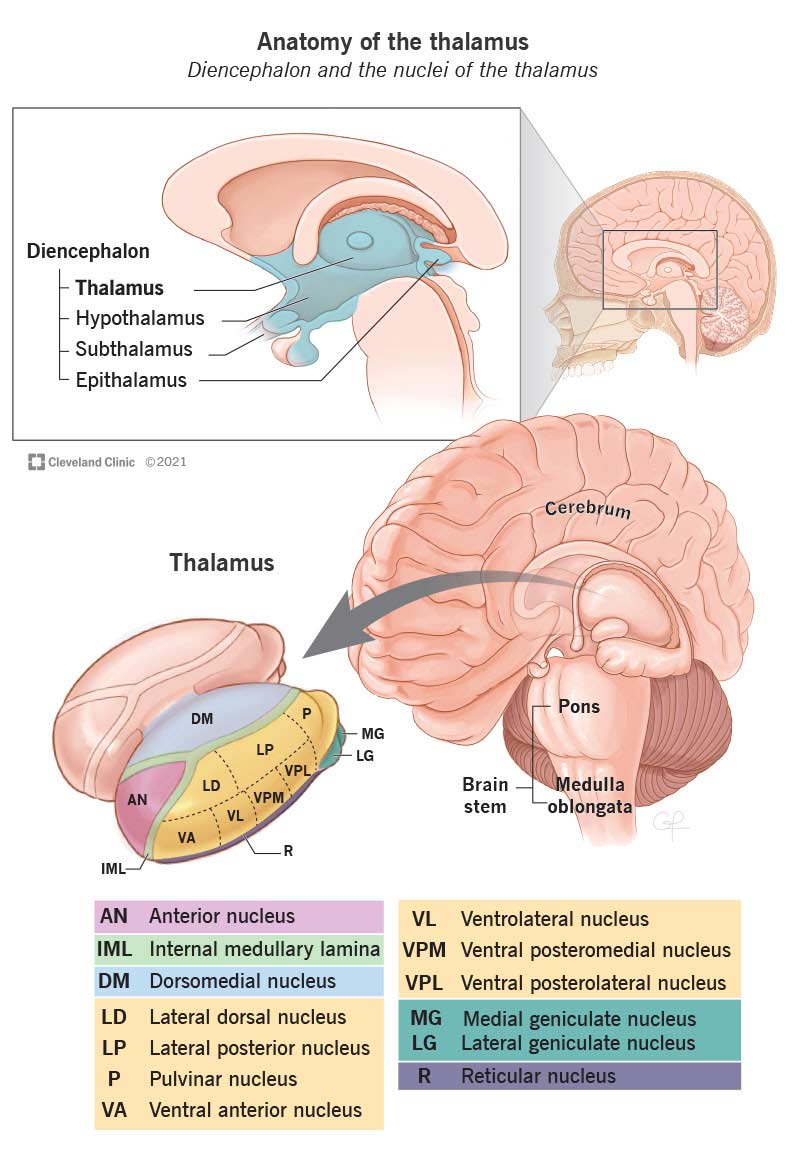
Your thalamus is an egg-shaped structure in the middle of your brain. It’s known as a relay station of all incoming motor (movement) and sensory information — hearing, taste, sight and touch (but not smell) — from your body to your brain. Like a relay or train station, all information must first pass through your thalamus before being routed or directed to its destination in your brain’s cerebral cortex (the outermost layer of your brain) for further processing and interpretation.
What does the thalamus do?
Your thalamus has many functions, including:
- Relaying sensory information. Taking in information, in the form of nerve signals, from all of your senses (taste, touch, hearing, seeing), except smell, into your brain. Each sensory function has a thalamic nucleus that receives, processes and transmits the information to its related area within your cerebral cortex.
- Relaying motor (movement) information. Similar to sensory information, motor pathways all pass through your thalamus.
- Prioritizing attention. Your thalamus helps decide what to focus on among the vast amount of information that it receives.
- Role in consciousness. Your thalamus plays a role in keeping you awake and alert.
- Role in thinking (cognition) and memory. Your thalamus is connected with structures of your limbic system, which is involved in processing and regulating emotions, formation and storage of memories, sexual arousal and learning.
Your thalamus also contributes to perception and plays a role in sleep and wakefulness.
How does your thalamus work?
Sensory impulses (“information”) travel through nerve fibers from your body through brain structures to your thalamus. Specialized areas of your thalamus, called nuclei, are each responsible for processing different sensory or motor impulses received from your body and then sending the selected information through nerve fibers to the related area of your cerebral cortex for interpretation.
This chart names some of the best known nuclei, their function and to what area of your cerebral cortex the information is ultimately sent.
NucleusSuspected function/roleCommunicates with what section of your cerebral cortexAnterior nucleusMemory, emotions, behavior regulationConnected to the hypothalamus; projects to the cingulate gyrusDorsomedial nucleusEmotional behavior and memory; attention, organization, planning and higher cognitive thinkingProjects to the prefrontal cortex and limbic systemVentral posterolateral nucleusRelay sensory information (pain, temperature and touch)Projects to the somatosensory cortexVentral posteromedial nucleusRelay sensory information from the faceProjects to the somatosensory cortexVentral anterior nucleusRelay motor information about movement/tremorProject to the substantia nigra, premotor cortex, reticular formulation and corpus striatumVentrolateral nucleusRelay motor informationProject to the substantia nigra, premotor cortex, reticular formulation and corpus striatumLateral posterior nucleusCognitive, determine prominent visual stimuliProjects to the visual cortexPulvinar nucleusProcess visual informationProjects to the visual cortexMedial geniculate nucleusProcess auditory informationPrimary auditory cortexLateral geniculate nucleusProcess visual informationVisual cortexReticular nucleusMakes up the outer covering of the thalamus; influences the activity of other nuclei within the thalamusDoesn’t project to the cerebral cortex
Where is the thalamus located?
Your thalamus lies above your brainstem in the middle of your brain. Although it may look like a single structure, you actually have two, side-by-side thalami, one in each hemisphere (side) of your brain. Being located in this central area — like the central hub on a bike wheel — allows nerve fibers connections (like the bike wheel’s spokes) to reach all areas of your cerebral cortex (the outer layer of your brain).
Technically, your thalamus is part of an area of your brain called the diencephalon, which includes your hypothalamus, subthalamus and epithalamus.
What happens if my thalamus is damaged?
Your thalamus is a central relay station for receiving incoming sensory and motor information. Your thalamus then sends this information to other parts of your brain. So, damage to your thalamus can affect many functions.
Symptoms of damage to your thalamus include:
- Memory loss (amnesia).
- Lack of interest or enthusiasm (apathy).
- Loss of ability to understand language or speak (aphasia).
- Trouble with attention, loss of alertness.
- Trouble processing sensory information.
- Impaired movement.
- Sleepiness.
- Chronic pain.
Damage to your thalamus can result in:
- Unconsciousness and even coma.
- Sleep disorders, such as insomnia and fatal familial insomnia (inability to sleep, leading to death).
- Thalamic aphasia (jumbled words, meaningless speech).
- Movement disorders, including tremors.
- Pain syndromes.
- Vision problems, including vision loss or light sensitivity.
- Thalamic pain syndrome (tingling or burning pain).
The main causes of damage to your thalamus include:
What conditions affect the thalamus?
Certain conditions that are affected by or damage your thalamus include:
- Fatal familial insomnia. Fatal familial insomnia is a hereditary prion (a type of protein) disease that attacks a particular chromosome. People who are affected develop worsening insomnia that’s joined by panic attacks, paranoia, phobias, hallucinations and a complete inability to sleep. This is followed by rapid weight loss, dementia and inability to speak until death.
- Creutzfeldt-Jacob disease and Fabry disease. These diseases share a feature that helps diagnose them called the pulvinar sign. A change in density at the back (posterior) of your thalamus appears in the shape of hockey sticks on an MRI scan.
- Korsakoff syndrome. Caused by alcohol, this syndrome can damage a certain structure in your brain, the mammillothalamic fasiculus, which extends into your thalamus.
Is the thalamus a target for any treatment?
The ventral intermediate nucleus of your thalamus is a target for deep brain stimulation for people with Parkinson’s disease that hasn’t been successfully treated with medications.
A note from Cleveland Clinic
Your thalamus serves as the main relay station for your brain. All motor and sensory signals (except smell) pass through this structure in the center of your brain. Your thalamus is arranged in regions, called nuclei, that each possesses specialization for dealing with that particular information. For example, information coming through your eye travels to your retina, and then onto your optic nerve. It then travels to the lateral geniculate nucleus of your thalamus, which processes the information and sends it to your primary visual cortex for interpretation. The signals are then passed onto your cerebral cortex for interpretation. Your thalamus also plays a role in regulating sleep and wakefulness, and is involved with consciousness.